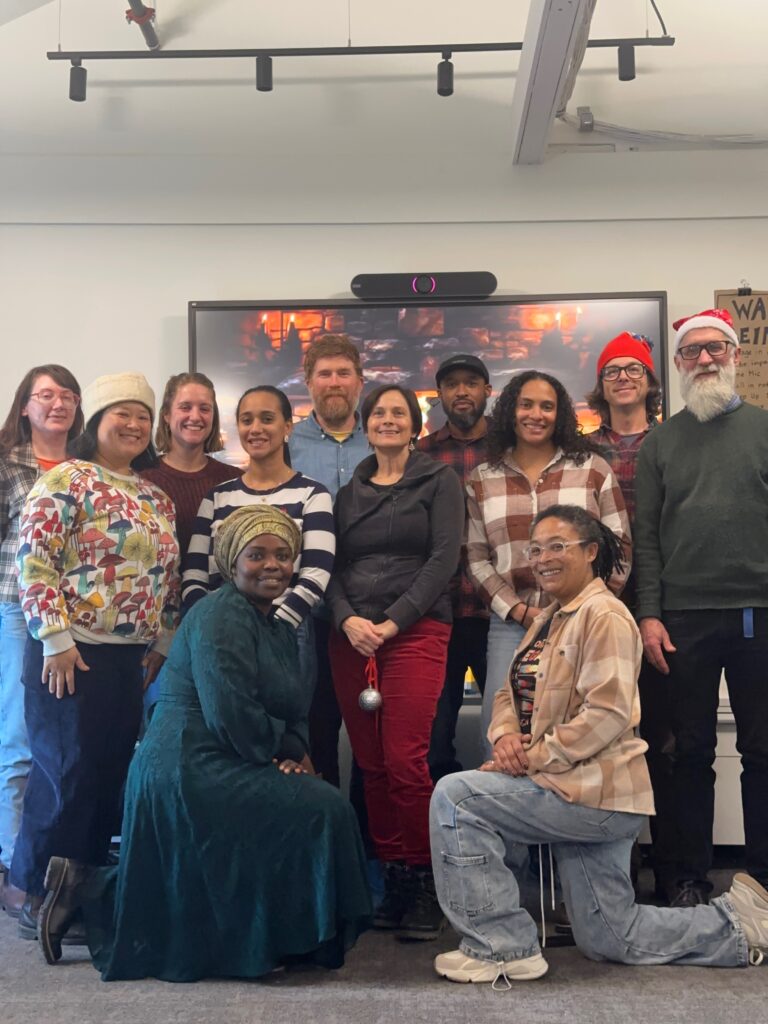
Every January, SCLT’s entire staff gathers for two days of reflection and conversation. Each program shares what they learned in the past year, guided by a set of questions that help frame the discussion: Who did you work closely with? What worked well? What challenged you? What data matters? Which partnerships strengthened, and which strained? What’s new and worth continuing? Where did you find moments of beauty, care, and joy? In February, we’ll gather again for one day to share our outlook for 2026.
2025 was marked by significant federal funding cuts that forced difficult staffing decisions. Our teams adapted, reorganized, and continued serving 25,000 Rhode Islanders through food access, community gardens, workforce development, and farmer support.
Our Produce Aggregation Program generated $140,881 in farmer sales in 2025, with 13 farm businesses participating. This represents meaningful progress, even as we acknowledge falling short of our $160,000 goal for farmer payouts, a gap that reflects the reality of reduced operational capacity. A major blow came in March with the cancelation of the USDA’s Local Food Purchase Assistance Cooperative Agreement, leaving us unable to offer farmers clear answers about market opportunities for months. Yet the program’s strength lies in its diversity. Our VeggieRx partnerships with Integra and Brown University Health distributed over 100 shares of fresh, local produce biweekly to people with diet-related health conditions. The partnership with Providence Parks now serves one recreation center with city council funding; we’re actively advocating for expansion to additional wards. And in a significant breakthrough, West African Superstore, owned and operated by Luna Walker at SCLT’s 404 Broad Street Healthy Food Hub, became the first community retailer in Rhode Island to participate in the Eat Well, Be Well incentive program. This program, the result of persistent collaboration between our Healthy Food Access Program Manager Kakeena Castro and the Department of Human Services, provides 50 cents in free produce for every dollar spent on fresh fruits and vegetables.
Our Farmer Training & Support program navigated significant organizational transitions in 2025. Ben Torpey stepped into the new Program Director role while Dan Roberts focused more on in-field work, and the team adapted to reduced capacity while maintaining core services. The year revealed both what’s possible and what’s breaking. An “atmosphere of dread” marked the landscape as teams processed staff reductions and grappled with having to say no to project requests due to lack of funding. Yet critical partnerships, particularly with URI Extension, created continuity even as capacity shrank. We’re seeing increased enrollment in Conservation Stewardship Programs (CSP) among our growers, a positive indicator of farmer investment in their operations and land stewardship. The Hmong Farm team completed significant infrastructure improvements with new signage, a LASA-funded tractor, and a functional well and water system, providing farmers with better tools and resources. We also deepened our focus on farmer business support, helping farmers complete annual farm business registrations with RIDEM and conducting post-season interviews to gather feedback and understand needs.
With roughly 300 gardeners across our community gardens network, 2025 was a year of steady participation rather than expansion. Staff layoffs in the gardens program meant our Farmer Training & Support team stepped into additional leadership roles in the Gardens program. Rather than collapse, the result was adaptation: Chandelle Wilson and Ben launched monthly garden leader meetings to process the transition and maintain connection across our network. Of 23 total garden leaders, 18 attended the first November meeting, a meaningful showing of resilience in the face of real loss.
Our Workforce Development Program served young people in Providence and Pawtucket in 2025, working across the Youth Enterprise Farm, City Farm, and Galego Community Farm. Despite reduced funding meaning fewer paid positions and fewer hours, we maintained a high retention rate among youth staff and deepened cross-cohort collaboration. The highlights speak to what happens when young people are given meaningful work and mentorship: four youth staff in Providence and two in Pawtucket graduated high school. Youth participated in field trips to Maisey’s Tree Farm, now in its third year of partnership, URI’s plant lab and animal farm, kayaking on the Blackstone River, and a Save the Bay boat trip to Prudence Island. Both program gardens were remarkably productive, yielding strawberries, watermelon, potatoes, carrots, and flowers funded through a Bloom RI grant. The cut flower garden at Galego became a community hub, directly encouraging residents to visit and engage with the space. We also launched important new trainings – First Aid/CPR certification and a Mental Health First Aid workshop – equipping young people with skills beyond agriculture.
One young person deserves particular mention: James Pastor Tzul, a former member of our youth staff, was recognized with an RIEEA Environmental Excellence Award. This recognition speaks to the leadership development happening on our farms and the real impact of the work young people do alongside our teams. Yet the year also revealed constraints. Reduced funding meant fewer opportunities for educational field trips and rural property visits. The partnerships that sustained us, particularly Groundwork Rhode Island in Pawtucket, now in its sixth year of collaboration, took time to build and continue to require intentional stewardship.
2025 revealed both SCLT’s capacity for adaptation and the toll of systemic disinvestment in food justice work. We did more with less because our farmers, gardeners, youth, and staff are deeply committed. But this is not sustainable, and we’re not pretending it is. The Cranston Food Hub construction beginning this week represents a necessary reinvestment in the infrastructure our farmers desperately need.
The real story of 2025 is the people, the farmers who kept growing despite uncertainty, the youth who showed up week after week, the community gardeners who tended their plots, and the staff who pivoted and persisted through a genuinely difficult year.
The work continues, in our gardens, on our farms, in the relationships we’re building with each other and our community.