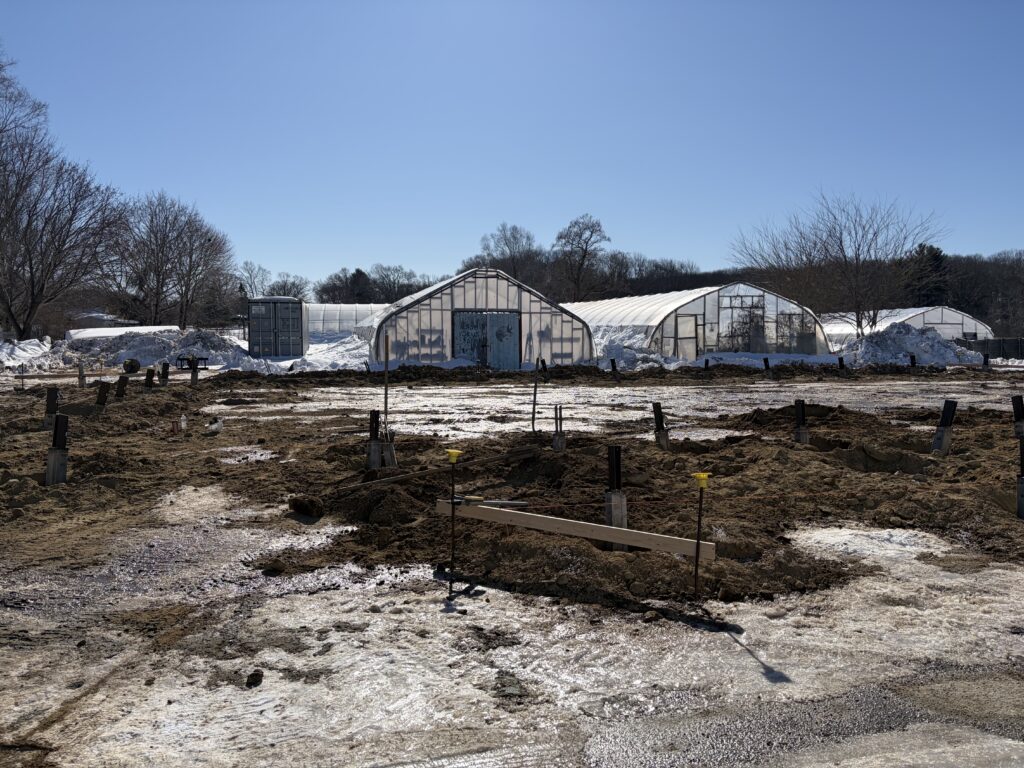
Construction of SCLT’s second food hub officially begins this week at Urban Edge Farm in Cranston. It’s a moment two years in the making and a testament to persistence through extended federal review processes and multiple rounds of revision. Now, after months of careful planning and coordination with experienced professionals, the vision is becoming concrete. Literally.
The journey began in January 2024 when SCLT submitted our application to the USDA’s Resilient Food Systems Infrastructure program. We waited. We revised. We adapted to changing federal guidance. And in March 2025, we received the official grant award letter. We were awarded the largest RFSI grant in New England and one of only four awards across the state of Rhode Island.
Since then, a dedicated team has been working to bring this to life. Project Director Matt Tracy, along with Ben Torpey, Dan Roberts, Kakeena Castro, Margaret DeVos, Isabelle Izobankiza, and Sam Shepherd, plus invaluable input from the broader team, have navigated permitting, site design, and contractor coordination.
Here’s the story: Our Produce Aggregation Program has exploded. In 2021, farmers in our network generated $49,000 in revenues. By 2025, that number reached $140,000. That growth reflects the quality of the produce and the deep demand in our community for fresh, culturally familiar food. It also means we’ve hit a wall. Our Farm-to-Market Center in Providence has reached capacity. We can’t process, store, or distribute more than we already are from that location. Building a new hub in Cranston, where most of SCLT’s produce is actually grown, is the next step. Over 20 farm operations at Urban Edge Farm sell produce through our aggregation program. More than 100 additional farmers work at nearby properties: Good Earth Farm, Hmong Community Farm, Snake Den Farm, Bami Farm, and independent producers increasingly contributing to our network.
The deeper challenge is Rhode Island’s agricultural reality. Our state has the highest agricultural real estate costs in the nation, six times the national average. For beginning farmers, especially those from historically marginalized communities, acquiring land and building infrastructure feels impossible. On our managed lands at Urban Edge and Good Earth, more than 75% of farmers identify as Black, Indigenous, or people of color. Two-thirds are women. Half live in South Providence. Many are immigrants and refugees from Southeast Asia, Africa, and the Dominican Republic who bring invaluable agricultural knowledge but face systemic barriers to land, markets, and infrastructure.
The new food hub addresses these barriers directly. By investing in modern produce aggregation, storage, and distribution infrastructure, we’re helping farmers increase production, improve product quality, and access new markets while improving food safety. This isn’t just about moving more vegetables. It’s about enabling farmers to build sustainable operations and claim economic power in a system designed to exclude them.
The facility itself, funded primarily through the USDA grant, will include modern indoor pack lines for sorting and processing, three walk-in coolers, a walk-in freezer, and a refrigerated delivery van connecting the new hub to our Farm-to-Market Center in Providence.
But this packhouse is just Phase 1. We’re thinking bigger. Over the next five years, we hope to transform Urban Edge Farm with a suite of improvements: upgraded water and sewer systems, HVAC, restrooms, electrical upgrades, drainage improvements, and road work.
This winter, we received a significant boost toward these aspirational goals. The Growing Justice Fund, a national funder supporting food justice work led by organizations centered on racial equity, awarded SCLT a grant to support the buildout of the food hub. It places us within a network of organizations across the country operating from the same conviction: food justice requires centering the voices, leadership, and ownership of communities most impacted by food system inequities. We’re also pursuing additional funding from NRCS and private donors to make these longer-term improvements real. Some will happen. Some may face regulatory barriers. Some may need to be reimagined. That’s the work ahead.
None of this happens alone. Building Futures Rhode Island has been instrumental in site improvements at Urban Edge and Good Earth Farms, and will continue supporting the new hub’s interior buildout. The Rhode Island Department of Environmental Management (RIDEM) has been a steadfast partner in this ongoing improvements project since 2002, when SCLT secured a long-term lease at Urban Edge Farm. That partnership reflects something deeper: RIDEM’s Division of Agriculture recognizes that supporting community-based food production is core to the state’s agricultural future. We’re honored to work alongside them.
Construction will be ongoing through 2026, with full facility operations commencing in 2027. We’ll see the steel structure rise by April, foundation and utility work through May and June, interior buildout over the summer, and equipment installation in the fall. Throughout this process, we’ll work closely with our farming partners to ensure a smooth transition, offering training on new equipment and best management practices.
This hub is being built not just for farmers, but with them. Our vision is to move toward greater farmer governance and decision-making as the hub matures, building something that farmers lead and own, not something imposed upon them.
The hub will serve approximately 150 local and regional agricultural producers, including farmers at Urban Edge and Good Earth, more than 30 from the Hmong United Association of Rhode Island land access project, and partner farms across the region. It will be cooperatively utilized and governed, designed to strengthen the broader farming community.
This facility represents an investment in the middle of our food supply chain, the infrastructure gap that has constrained what’s possible for small, historically excluded farmers. As we lay the groundwork this week, we’re grateful for the farmers, partners, funders, and community members who’ve helped bring us to this pivotal moment.
Stay tuned for more updates on this exciting project!